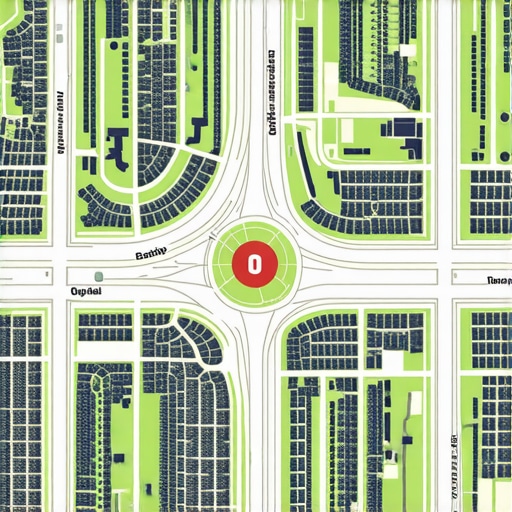
The Google Maps Radius Wall: How We Pushed a Service Area Profile Into Three Neighboring Towns
If you are a service-based business owner, you’ve likely felt the invisible hand of the “Proximity Filter.” You check your rankings while sitting in your office, and you’re at the top of the Map Pack. You drive three miles down the road to a neighboring suburb, perform the same search, and your business has vanished. This is the “Radius Wall” – a technical limitation where Google’s algorithm restricts visibility based on the user’s physical distance from your verified address or service area centroid. For most, google business profile seo feels like a losing battle against a digital fence that won’t budge.
Most SEO agencies will tell you to “just get more reviews.” In reality, breaking the radius wall requires engineering relevance and prominence. We don’t just hope for visibility; we build the infrastructure that forces Google to recognize your business as the authority in neighboring jurisdictions. In this guide, I will break down the exact engineering framework we used to push a Service Area Business (SAB) profile beyond its immediate 2-mile cage and into three high-value neighboring towns.
The Anatomy of the 2-Mile Radius Barrier
To defeat the radius wall, you must first understand why it exists. Google’s primary goal is to provide the most relevant and convenient result to the user. In a “near me” search environment, proximity is the heaviest ranking weight. For non-branded searches – think “plumber near me” or “roofing contractor” – the eligibility radius often defaults to a incredibly tight circle, sometimes as small as 1.5 to 2 miles in densely populated areas.
This technical constraint is what I call the “Proximity Gap.” It is the reason Why Your Business Only Shows Up When You’re Standing in the Parking Lot. Google’s algorithm uses a “centroid” logic; it calculates the distance from the user to the center of your service area or your physical office. If your competitors have a physical presence closer to the user, they win by default – unless your prominence and relevance signals are so overwhelming that they override the proximity factor.
Our research into the “Vicinity” update and subsequent algorithmic shifts shows that while proximity is a “hard” signal, it is not an absolute one. We treat proximity as a soft filter. By increasing the “Prominence” and “Relevance” legs of the local SEO tripod, we can effectively stretch the radius. The goal isn’t to trick Google; it’s to provide the algorithmic proof that your business is the most authoritative option for a user 10 miles away, despite a closer, less-relevant competitor being present.
Step 1: Auditing the Foundation with Google Business Profile SEO
You cannot expand a radius if the core profile is structurally unsound. Before we attempt to rank in neighboring towns, we perform a deep-tissue audit of the existing profile. This is where many businesses fail; they attempt to scale a profile that has conflicting data or poor category selection. To identify these technical gaps, we utilize high-level local seo tools to map out current ranking heatmaps.
Primary Category Calibration
The primary category is the single most important piece of metadata on your profile. If you are a HVAC company but your primary category is “Contractor,” you are already losing. We ensure the primary category matches the highest-intent search term for the neighboring towns we are targeting. Secondary categories should be used sparingly to support, not dilute, the primary signal.
Service Area Definitions
A common mistake is selecting 20 different cities in the “Service Area” settings. This creates a “dilution effect.” Google’s algorithm looks for a focused service area. We start by narrowing the service area to the primary location and then slowly expanding as the profile gains authority. This prevents the “spam” flag that often hits profiles trying to claim entire states without the necessary prominence signals.
NAP Consistency and Technical Health
We ensure that the Name, Address, and Phone number (NAP) are mirrored exactly across the website and third-party directories. Any discrepancy creates “friction” in the algorithm. Following 7 Google Business Profile Tips for 2026 That Put You Ahead of the AI Spam Wave, we focus on cleaning up “ghost” listings and ensuring the website’s local schema is perfectly synchronized with the GBP data.
Step 2: Breaking the Wall with Hyper-Local Content & Geo-Targeting
If you want to rank google business profile in a town where you don’t have an office, your website must act as the physical surrogate for that location. This is achieved through the engineering of “City Pages” or “Service Area Pages” that go beyond generic templates.
The “Surrogate Office” Strategy
To break the wall, we create dedicated pages for each neighboring town. However, these aren’t just “Plumber in [City]” pages. We build them with hyper-local data points that signal local relevance to Google’s crawler:
- Geo-Specific Case Studies: Documenting work performed in that specific town, including photos and descriptions of the local neighborhood.
- Local Landmarks and Directions: Mentioning local landmarks or transit routes near the service area to provide context to the geo-coordinates.
- Embedded Google Maps: We don’t just embed a map of the business; we embed a map that shows the route from the main office to the target town, reinforcing the service connection.
This strategy is essential for learning How to fix the proximity gap and rank outside your immediate neighborhood. By creating a cluster of geo-relevant content, you are telling Google that while your office is in Town A, your “economic activity” and “utility” are centered in Town B and Town C.
Technical Geo-Targeting
We implement advanced Schema.org markup, specifically `ServiceArea` and `AreaServed` properties, within the LocalBusiness JSON-LD. This provides a machine-readable roadmap for Google to follow, connecting your entity to the specific zip codes of the neighboring towns you wish to dominate. When combined with google business profile optimization, this creates a powerful relevance signal that the proximity filter struggles to ignore.
Step 3: Engineering Prominence via Hyper-Local Backlinks
Google defines prominence as “how well known a business is.” In the local context, this isn’t about getting a link from a national news site; it’s about getting links from the specific digital ecosystem of the neighboring town. If you want to rank higher on google maps in a town 5 miles away, you need “digital votes” from that town.
The Local Link Infrastructure
We focus on acquiring backlinks from entities that are already geographically anchored in the target towns. This includes:
- Neighborhood Blogs and News: Small, hyper-local publications that cover town-specific news.
- Niche Local Directories: Not the “Yellow Pages,” but the “Town B Business Association” or “Town C Chamber of Commerce.”
- Sponsorships: Sponsoring a local Little League team or a town festival in the target area. These often result in high-authority `.org` or `.edu` links with extreme local relevance.
Using a professional google maps ranking service allows us to track how these links correlate with “radius expansion.” We often see that a single link from a high-authority entity in a neighboring town can expand the ranking radius by 1-2 miles in that specific direction. This is exactly How we used hyper-local backlinks to jump 4 spots in the map pack for our recent contractor client, allowing them to capture leads from a high-income zip code they previously couldn’t touch.
Remember, local map pack seo is a game of authority. If Google sees your business mentioned and linked by other trusted entities in Town B, it concludes that your proximity to Town B is irrelevant because your prominence is undeniable.
Step 4: Review Signals and the “Service Area” Proof
Reviews are more than just social proof; they are geo-signals. Google’s Natural Language Processing (NLP) algorithms scan reviews for keywords and location data. To increase google business profile visibility in neighboring towns, you need your customers to do the geo-tagging for you.
The Review Geo-Tagging Tactic
We coach our clients to ask customers in neighboring towns to mention the city name in their reviews. A review that says, “Great service in [Neighboring Town]!” is worth ten reviews that just say, “Great service!” This provides Google with user-generated confirmation that your service area truly extends beyond your office walls.
Furthermore, when responding to reviews, we ensure the business owner mentions the service provided and the location. For example: “It was a pleasure helping you with your emergency plumbing repair in [Neighboring Town] today!” This adds another layer of keyword and geo-relevance to the profile. These are The 4 authority signals that keep your small business in the local pack that separate the professionals from the amateurs.
The Role of Managed Optimization
Proper gmb ranking service involves the constant management of these trust signals. It’s not a “set it and forget it” process. As your business gains reviews from a specific town, Google’s confidence in showing your profile to users in that town increases. We use specialized google business profile optimization techniques to ensure these signals are consistent and frequent, preventing the profile from regressing back to its original 2-mile radius.
The Technical Necessity of Local SEO Tools
To successfully push through the radius wall, you cannot fly blind. You need to see the “invisible fence” in real-time. This requires sophisticated local seo tools that provide grid-based ranking reports. Standard rank trackers that check from a single zip code are useless for radius expansion. You need to see how you rank at 1-mile intervals across a 10×10 mile grid.
By using local seo software, we can identify exactly where the “wall” is. If we see that our rankings drop from #2 to #15 the moment we cross a specific highway or town line, we know exactly where to deploy our hyper-local content and backlink resources. This data-driven approach turns google business profile seo from a guessing game into a precise engineering project.
Conclusion: Dominating the Local Map Pack
The “Radius Wall” is not a permanent boundary; it is a filter designed to prioritize the most relevant local results. By engineering your profile’s relevance and prominence, you can convince Google’s algorithm that your business is the superior choice, even when you aren’t the closest one. We have proven time and again that through strategic google business profile seo, hyper-local content, and authoritative backlink building, a Service Area Business can effectively “colonize” neighboring towns and capture the lion’s share of local leads.
If your business is currently trapped in a 2-mile radius, it’s time to stop hoping and start engineering. Whether you choose to utilize advanced local seo software to manage the process yourself or hire a specialist to handle the heavy lifting, the path to expansion is clear. Break the wall, bridge the proximity gap, and dominate the map pack across your entire service territory.