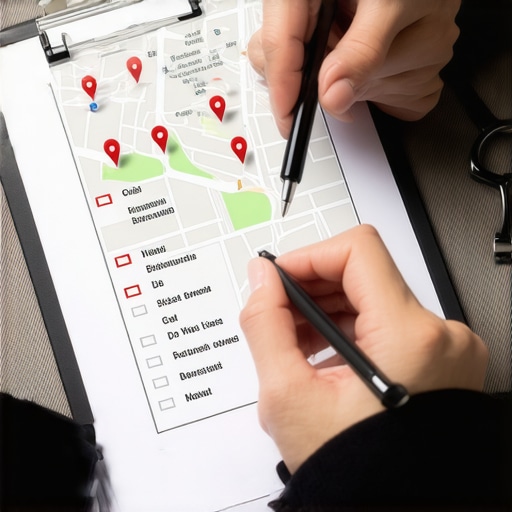
A complete checklist for manual local profile optimization
I spent three months fighting a hard suspension for a plumbing client whose listing was nuked simply because they shared a suite number with a defunct law firm. Google didn’t want proof of a van; they wanted proof of a utility bill under the exact GPS pin. That was my welcome to the hyper-local layer. It is a world where spatial forensics outweighs marketing flair. If your physical address is not a verified beacon of trust, your ranking is a temporary glitch. This guide serves as a manual for those who need to repair the damage and lock down their proximity authority.
The ghost in the GPS coordinates
Manual local profile optimization requires verifying the exact latitude and longitude coordinates, cleaning up duplicate records, and ensuring the Google Business Profile primary category matches the core business intent. This process removes technical friction that prevents the Map Pack from displaying a business to nearby users. Every coordinate shift of a few meters can alter your visibility in a high-density urban environment. You must audit your map pin location with precision. Sometimes the pin is moved by an automated suggestion or a malicious edit. If the pin is not exactly on the entrance of your physical building, the proximity signal weakens. I have seen rankings jump four positions simply by moving a pin thirty feet to the correct side of a street. You should also check for why your location strategy is getting your listings merged by mistake which often happens when GPS data overlaps with another entity in the same building.
Why your physical address is a liability
Fixing a mismatched business address and phone number is the primary step in securing your local search visibility and avoiding algorithmic filters. Google uses a cross-referencing system that checks your NAP data against third-party aggregators and government records. If you share an address with five other businesses without a distinct suite number, you are a red flag. The algorithm views shared addresses as potential lead generation shells. You need a dedicated utility bill or a lease agreement. When businesses move, they often leave a trail of digital debris. Old addresses on forgotten directories confuse the mapping bot. You must use how to clean the profile data google uses to rank you to ensure that the historical record of your location is spotless. One bad citation on a local chamber of commerce site can trigger a partial suspension where features like posts or products are disabled.
“Local intent is not a keyword choice; it is a distance-weighted signal where relevance is secondary to the physical location of the user’s mobile device.” – Map Search Fundamental
The three mile radius that determines your revenue
Proximity is the most powerful ranking factor in the modern Map Pack because Google prioritizes the closest relevant result to the user to minimize travel time. This creates a proximity bubble that can shrink if your profile lacks authority or has inconsistent data. You cannot force a rank ten miles away if you have not dominated the first three miles. To expand this reach, you must demonstrate real-world activity within that radius. This involves uploading photos with local metadata and generating reviews from customers located in specific neighborhoods. If you find your reach is narrowing, you should investigate why your proximity bubble shrank and how to expand it again to regain lost territory. The logistics of the map require you to be the most trusted option in your immediate square mile before the algorithm grants you visibility in the next township.
Forensic cleaning of the review corpus
Review cleanup services are essential for profiles hit by fake review attacks or those struggling with a sudden drop in consumer trust scores. Google now uses machine learning to detect patterns in review velocity and IP origin. If a competitor drops twenty negative reviews from a VPN, you cannot just hope they go away. You must perform a forensic audit of the user profiles and report them with evidence of a coordinated attack. Conversely, if you have used cheap services to inflate your rating, you are sitting on a time bomb. You need to understand the problem with using cheap review cleanup services for your profile before the automated spam filter nukes your entire account. Cleaning the slate is better than maintaining a toxic profile. Trust is the currency of the Map Pack.
Local Authority Reading List
- The DIY checklist for polishing your business profile to perfection
- How to use verified location data to outrank local competitors
- The local seo software that actually tracks proximity trends
- How to audit gmb profile with a toolkit
The technical trap of mismatched metadata
Mismatched business hours and secondary phone numbers often trigger a silent suspension where your profile remains live but stops appearing in the top three results. Consistency is a proxy for reliability. If your website says you close at five but your Google profile says six, the bot loses confidence. I have seen profiles where a business name was corrected, but the ranking lagged for weeks. You must learn about fixing the ranking lag after a business name correction to ensure the update propagates through the index correctly. Check your structured data. Your LocalBusiness schema must match your profile exactly. Any deviation is seen as a sign of a neglected listing. A neglected listing is a ranking risk.
Winning the AI overview through information gain
Optimizing for AI Overviews in local search requires providing unique data points such as high-resolution images of your specific service equipment and detailed responses to common local questions. AI models look for information gain that standard profiles do not provide. Don’t just list your services. Describe the specific tools you use or the exact neighborhoods you serve. This creates a data-rich profile that AI models can cite as a primary source. While others focus on keywords, you should focus on removing the ai fluff that is watering down your local authority. AI content on your website can bleed into your local rankings. Google wants the human touch in local results. It wants the smell of diesel from a real plumber’s van, not a stock photo of a wrench.
“Relevance is measured by how well a business profile answers the specific nuances of a local query, including specialized attributes and consumer-generated content.” – Vicinity Research Group
The checklist for recovering a suspended profile
A manual audit for suspension recovery involves checking for duplicate listings, verifying that the business name does not contain illegal keywords, and confirming the physical location exists. If your listing was hit by a manual action, you must provide the proof documents. This includes photos of your signage and your business license. Use the checklist for recovering a suspended google business profile to organize your appeal. Do not guess. Do not lie to the support team. They have access to historical Street View data and previous edits. If you try to hide a keyword-stuffed name, they will find it. Clear the data. Show the truth. Reclaim your spot. [image_placeholder_1]
Strategic use of toolkits for competitor map spam
Using a toolkit to spot competitor map spam allows you to identify fraudulent listings that are pushing your legitimate business out of the local pack. Many industries are plagued by lead-gen sites using fake addresses. You must report these to maintain your fair share of the market. Use using toolkits to spot competitor map spam to find the patterns that indicate a fake listing. This might be a missing suite number or a phone number that redirects to a call center in another state. When you clear the spam, the proximity weight resets. You will find that without the noise of fake listings, your real location naturally rises to the top. This is not about being a snitch. This is about protecting the integrity of your local economy. Local SEO is a battle of accuracy. The most accurate data wins. Every time.