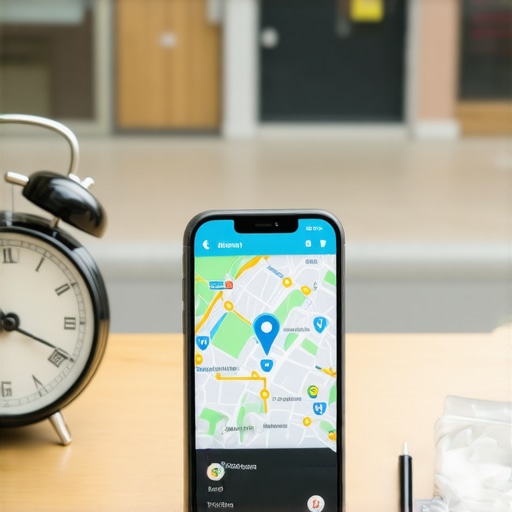
I operate in the world of nodes, dispatch loops, and transit times. To me, a Google Business Profile is not a marketing asset; it is a proximity beacon that must be calibrated with the precision of a logistics hub. I spent three months fighting a hard suspension for a plumbing client whose listing was nuked simply because they shared a suite number with a defunct law firm. Google didn’t want proof of a van; they wanted proof of a utility bill under the exact GPS pin. That experience taught me that the map algorithm does not care about your branding. It cares about the mathematical validity of your physical existence. When a user types ‘near me’ into their phone, a complex spatial calculation occurs in milliseconds. The engine looks at the GPS coordinate salience of your office and cross-references it with your historical data points. If you have been messing with your location data, you are likely suffering from a shrinking proximity bubble.
The truth about temporal proximity and hours history
Temporal proximity signals analyze your business hours history to determine if you are open during a user search. Google uses historical data to predict reliability. Inconsistent hours lead to ranking drops because the algorithm prioritizes businesses with a high trust score regarding their stated operational times. This is why the impact of a clean business hours history on your local trust score is a factor many overlook. If your hours flicker like a faulty neon sign, the engine treats you as a high-risk dispatch. I have seen businesses lose thirty percent of their call volume simply because they changed their closing time by thirty minutes without updating their citations. This creates a data mismatch that triggers a silent suspension. You need a gmb keyword and category research toolkit to ensure your primary categories align with when your customers are actually searching. If you are a 24-hour locksmith but your history shows frequent manual edits to your hours, the algorithm suspects map spam.
Why your physical address is a liability
Your address serves as the anchor for the proximity bubble which can shrink based on competitor density. If your location is too close to a high volume of similar businesses, your listing might be filtered out. Managing this requires a uniform data strategy to ensure Google understands your unique service area. This is often where seo services to fix gmb ranking loss after address change become necessary. Moving even two blocks can push you out of a high-intent centroid. I think of it as a delivery zone. If you move your warehouse, your delivery times change. If you move your office, your map ranking will fluctuate. You must understand the secret to maintaining 3-pack rankings during a business move before you sign a new lease. Many owners assume the rank follows the brand; the rank follows the dirt. If that dirt is already crowded with keyword-stuffed business names, you are in for a fight. Using seo services to detect and fight competitor gmb spam attacks is the only way to clear the weeds around your pin.
“Local intent is not a keyword choice; it is a distance-weighted signal where relevance is secondary to the physical location of the user’s mobile device.” – Map Search Fundamental
The three mile radius that determines your revenue
Proximity is the most weighted ranking factor in the local pack algorithm today. The engine creates a virtual fence around the user, and if you are outside that three-mile radius, your relevance score must be astronomical to appear. Expanding this radius requires more than just reviews. It requires best toolkit to improve local search rankings that can analyze spatial data. You might notice why your proximity bubble shrank and how to expand it again involves technical fixes like cleaning up your backlink profile. I often recommend seo services to remove google manual action if your expansion efforts were too aggressive. If you tried to tag every city in the county on your location pages, you likely triggered a spam filter. The engine sees that as a logistics error. You cannot be in two places at once without two distinct, verified pins. For those managing multiple sites, seo services to fix mixed listings for multi location businesses are a requirement to prevent data cannibalization.
The ghost in the GPS coordinates
Hidden data errors like ghost citations or mismatched suite numbers can kill your map prominence. These errors act like a broken link in a supply chain, stopping the flow of authority to your profile. You need tools to find gmb categories and keywords to ensure your metadata is consistent across the web. I have seen listings drop because of why broken links on your contact page destroy your map prominence. It seems small, but if the bot cannot crawl your contact info, it cannot verify your GPS coordinates. This is a common issue for those who need local seo services to fix ranking loss after moving city or service area. The old data lingers like a ghost. You need a hard scrub of the local ecosystem. I suggest looking at the data cleanup method for profiles with mixed language issues if your business serves a diverse area. Consistency is the only currency Google accepts.
Local Authority Reading List
- How to audit your business hours history to prevent a silent suspension
- Why your local profile authority depends on more than just citations
- The reason your business hours are resetting on your map profile
- How to use professional software to audit the local 3-pack
- Shielding your business from future map profile suspensions
Fighting the map spam war
Competitors often use fake addresses or keyword-stuffed names to hijack your local traffic. This is not just annoying; it is a direct violation of the maps terms of service that pushes honest businesses down. You must employ seo services to detect and fight competitor gmb spam attacks to maintain your position. I once tracked a ‘lead gen’ shop that had fifty pins in a single zip code; all of them were virtual offices. We had to report every single one to restore the client’s visibility. This is why how to wipe out competitor map spam without a profile suspension is such a critical skill for a logistics manager. You are essentially policing your own delivery route. If the road is blocked by fakes, your customers cannot find you. Using local seo services to fix banned gmb listing might be necessary if you were caught in the crossfire of a spam sweep. Google’s AI is blunt; it often deletes the good with the bad.
Navigating the ownership change trap
Changing the primary owner of a listing can trigger an immediate re-verification or suspension. The algorithm views a change in ownership as a potential high-risk event, especially if the new owner’s account has a history of spam. You need seo services to restore map pack visibility after listing ownership change to navigate this safely. I always advise clients to check the proof documents you need to fast track profile recovery before making the switch. If you don’t have a video walk-through and a business license ready, don’t touch the settings. Many businesses find themselves needing local seo services to fix banned gmb listing because they updated the phone number and owner at the same time. That is a red flag in the system. It looks like a hijacking. Keep your changes incremental. Keep your data uniform. The system rewards stability over speed.
“Proximity is a physical constraint that digital signals can only amplify, not replace. A business that is not physically present is not locally relevant.” – Vicinity Algorithm Whitepaper
Tools for the local intelligence agent
Standard rank trackers often fail because they do not account for the user’s precise GPS location. To see what your customers see, you need a gmb keyword and category research toolkit that uses grid-based tracking. This allows you to see exactly where your proximity bubble ends. I rely on the only maps software that delivers real 3-pack results to get an accurate picture. If you are using tools to find gmb categories and keywords, make sure they are pulling live API data. The ‘near me’ search is fluid. It changes based on time of day and traffic patterns. If you aren’t monitoring these fluctuations, you are flying blind. I recommend best toolkit to improve local search rankings for anyone serious about dominating their local centroid. You need to know if you are losing ground to a new competitor or if your own site updates are to blame. Often, why your map rankings drop every time you update your site is due to a technical error in the schema markup. Fix the data, fix the rank. The logistics of search are simple once you respect the physics of the map.