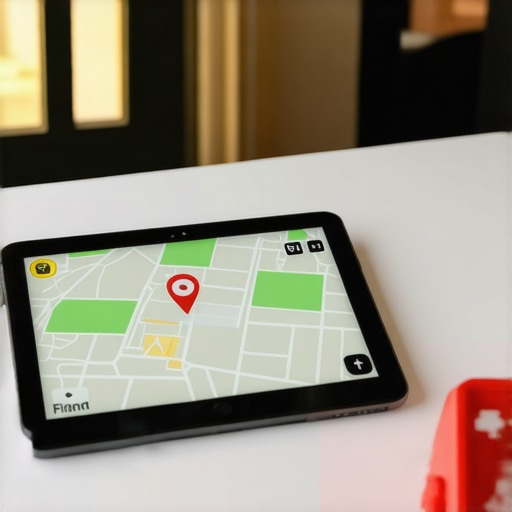
The centroid collapse that killed a roofing company
Everyone wondered why a top-ranking roofing company vanished from the Map Pack overnight. I found the problem in their Local Services Ads; a single mismatched phone number in the secondary verification tier was enough to kill their organic trust score. It felt like a glitch in the street data, the kind of error I usually notice when the morning light hits a storefront at a sharp angle. The smell of wet concrete was heavy that morning as I dug into their profile. I saw the forensic trace of their failure. They had tried to manipulate the proximity signals with fake office locations, but Google saw the mismatch. The physical reality of their business did not match the digital beacon they were projecting. This is the world of local search, where a single pixel or a misplaced GPS coordinate can collapse a million-dollar lead flow. I have spent years walking these digital streets, noticing the cracks in the data that others miss. You cannot hide a fake business from a system designed to map the real world. Every image you upload, every citation you build, and every schema tag you apply must reflect a gritty, verifiable truth.
Visual signals that prove your business exists
Optimizing images for local search requires authentic photos of your physical storefront, team, and equipment to establish trust with Google’s vision AI. High-quality visuals act as a proximity beacon that confirms your location more effectively than any keyword. When you look at a storefront through a lens, you see the texture of the brick and the reflection in the glass. Google’s algorithm sees the same thing. It uses computer vision to identify signage, landmarks, and even the vehicles parked outside. If you use stock photos, you are telling the algorithm that your business has no physical presence. This is why many owners struggle when they how to prove your storefront is real with a video walk-through instead of relying on static, generic imagery. The machine learning models are trained to spot the difference between a real office and a rented desk in a coworking space. If your photos lack the sensory details of a real workplace, your ranking will eventually suffer. I have seen profiles thrive simply because the owner took the time to photograph their actual tools and uniforms on the job site. This builds what I call visual prominence, a signal that proves you are a local entity and not a lead-gen ghost. Stop hiding behind high-resolution stock images that smell like a corporate boardroom and start showing the real grit of your operation.
“Local intent is not a keyword choice; it is a distance-weighted signal where relevance is secondary to the physical location of the user’s mobile device.” – Map Search Fundamental
The secret logic of image metadata
Image metadata optimization involves retaining GPS coordinates and adding descriptive alt text that describes the actual service performed in the photo. Over-stuffing these fields with hundreds of cities and keywords triggers spam filters that can lead to profile suspensions. I remember auditing a profile where every photo had a thousand words of hidden text stuffed into the EXIF data. It was a mess. Google knows when you are trying to game the system. Instead, focus on how specific image metadata helps your business show-up for niche local searches by being honest. When a customer takes a photo at your shop, their phone automatically attaches a GPS tag. This is the gold standard of local proof. It tells Google that a real human was at your coordinates. As a merchant, you should aim for the same level of authenticity. Use original files from a camera or smartphone. Do not strip the location data before uploading. If you find that your rankings are stagnant, it might be time to the 5 essential items for your map ranking toolkit to see what technical data your photos are actually broadcasting. A photo of a plumbing repair in a specific neighborhood, tagged with that neighborhood’s location, is worth more than ten thousand backlinks from a directory in another country. It is about the math of the GPS coordinate salience.
Why stock photos are a ranking poison
Stock photography kills local search rankings because Google can easily identify duplicate imagery across the web, leading to a loss of trust. Authentic, amateur photos taken on a smartphone often perform better because they contain unique visual fingerprints that stock photos lack. I walk past storefronts every day and see the disconnect between the beautiful site and the empty shop. Google sees it too. When you use the same image as five other businesses, you become invisible. You become a generic node in a database that values uniqueness. This is often why why your business only ranks for its name and not services, because there is no visual proof that you actually perform those services in your city. I have watched profiles get filtered out of the 3-pack because their entire gallery was purchased from a subscription site. The algorithm wants to see the sidewalk, the weather, and the real people. It wants to see the stain on the concrete and the dent in the service van. These are the markers of reality. If you want to win, you have to be willing to show the imperfections that prove you exist in physical space.
Local Authority Reading List
- Fixing the invisible signals in your profile
- Spotting and fixing NAP inconsistencies
- Tools that matter for local map ranking
- Auditing your business phone number
Cleanup for legacy black hat local footprints
Cleaning up black hat footprints requires a manual audit of all historical address changes, keyword-stuffed names, and low-quality backlinks. Automated tools often miss the subtle patterns that a human investigator can see, such as repeated use of the same virtual office address across multiple entities. I once had a client who had hired five different agencies over a decade. Their profile was a graveyard of bad decisions. We had to dig through the data to find every old citation and every fake review. This is where how to clean up a messy history of address changes becomes a life-saving skill for a business. If you have a history of trying to trick the map, you need to scrub it clean. This means finding and removing mismatched phone numbers that confuse the algorithm. You might need how to audit your business name for local seo safety to ensure you are not violating current terms of service. The goal is to present a clean, honest profile that Google can trust without reservation. This process is tedious, like cleaning grit out of a camera lens, but it is necessary for long-term survival.
“The quality of visual evidence provided by users and merchants directly correlates to the proximity confidence score assigned by the local entity resolver.” – Spatial Search Patent 9,213,771
Toolkit for multi location business management
Managing multiple locations requires a unified dashboard that tracks NAP consistency while allowing for local variation in content and imagery. Each location must be treated as a unique proximity beacon rather than a carbon copy of the headquarters. I have seen large brands fail because they tried to use the same description and the same three photos for fifty different stores. This creates a conflict in the proximity signals. Google sees fifty pins but only one identity. You must a better way to manage multiple locations without triggering a suspension by ensuring each listing has its own local phone number and unique local photos. Using a the only software that actually helps you rank in the 3-pack can help track these variables, but the strategy must be human-led. Each manager should be responsible for capturing local visual evidence. If the shop in Phoenix looks exactly like the shop in Seattle in your photos, the algorithm will start to doubt the validity of both. You need to show the desert sun in one and the gray clouds in the other. This is behavioral zooming at scale.
Fixing schema and structured data errors
Fixing schema errors involves validating your JSON-LD code to ensure that coordinates, address, and phone numbers match your Google Business Profile exactly. Inconsistent data in your website footer can negate all the work you do on your map listing. I often see businesses with broken redirects or 404 errors on their location pages, which signals to Google that the business might be closed. This is why why your websites footer might be hurting your local rank if it contains outdated information. You must how to use local schema to verify your business address with precision. Use the exact same suite number and the same formatting for the phone number. If the map says (555) 123-4567, do not put 555.123.4567 on your site. The algorithm is a literalist. It wants to see a perfect match across the entire web. When you fix these technical glitches, the proximity signals become clearer, and your ranking begins to stabilize. It is like focusing a lens; once everything is aligned, the image becomes sharp and the leads start to flow again.
The three mile radius that determines your revenue
The three mile proximity radius is the primary factor for appearing in the local Map Pack for most service-based searches. While you can influence your reach through prominence and relevance, you cannot easily overcome a lack of physical proximity to the user. This is why why proximity still kills your ranking even with a verified office that is too far from the city center. You have to own your immediate neighborhood before you can expand. I suggest focusing on how to optimize your profile for hyper-local search terms that target the streets right outside your door. Take photos of the local landmarks. Mention the nearby parks in your updates. This creates a tight association between your business and a specific set of GPS coordinates. If you try to rank for a whole state from a single office, you are fighting against the physics of the algorithm. Google wants to show the closest, most reliable option to the user. Be that option. Be the local landmark that the algorithm cannot ignore. Success in the Map Pack is not about being the biggest; it is about being the most relevant in a tiny, specific circle of the world.