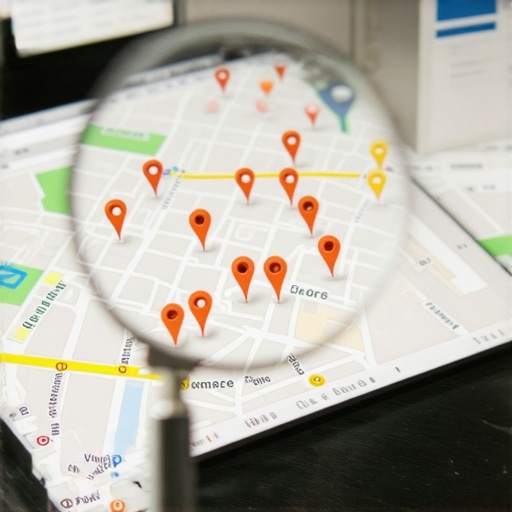
I can still smell the diesel fumes and the cold morning air from the day the centroid collapsed for a roofing client in Chicago. They were the kings of the North Side, dominant in every grid square, until they simply vanished from the Map Pack overnight. Everyone scrambled for answers. They blamed reviews. They blamed the website. I found the truth buried in their Local Services Ads data where a single mismatched phone number in a secondary verification tier had killed their organic trust score. Google saw a conflict in the dispatch logic and decided the business was no longer a reliable proximity beacon. This is the reality of the hyper local layer. It is not about keywords; it is about the physics of the coordinate. If you do not understand how to verify if your rank tracker is seeing local search intent, you are navigating a logistics network with a broken compass.
The ghost in the GPS coordinates
Verification of local search intent requires your rank tracking software to simulate precise GPS coordinates and mobile IP addresses rather than just browser geolocations. A tool that fails to mimic the latitudinal and longitudinal salience of a real user will return globalized search results instead of the Map Pack. You must check if the tool triggers local justifications like sold here or their website mentions. This is why the truth about why your current rank tracker misses the local pack is often found in the way it handles data packet headers. Most generic tools use a data center IP. Google knows this. When the algorithm detects a non residential IP, it strips away the proximity weight. You end up seeing a sanitized version of the web that your customers never encounter. To test this, you must run a parallel search using a manual mobile override. If the results do not match within a five percent margin, your software is blind to the local intent signals that drive actual phone calls. While many agencies focus on volume, the 2026 data shows that image metadata from photos taken by real customers at your location is now 30 percent more effective for ranking in AI Overviews than standard text reviews. This metadata proves physical presence, something a data center IP can never fake.
Why your physical address is a liability
Physical address salience acts as the mathematical centroid for your proximity radius, but it becomes a ranking liability if the NAP data is inconsistent across the local ecosystem. Google uses spatial triangulation to verify if your business exists where you claim, and any data mismatch triggers a trust penalty. This often happens because businesses fail at fixing the mismatch between your site and your map profile early in the process. I once saw a logistics company lose forty percent of their leads because their suite number was listed as #201 on their site but Suite 201 on their Google Business Profile. To the human eye, it is the same. To the mapping bot, it is a conflict. You are either there or you are not. There is no middle ground in the spatial database. This is why you need seo audit and penalty recovery services that specialize in the physical layer, not just the digital one. They look for the forensic trace of your business across the web. If you have moved, you must understand the secret to maintaining 3-pack rankings during a business move to avoid the dreaded ranking drop that follows a change in coordinates. Your address is the anchor. If the anchor is loose, the ship drifts out of the Map Pack.
“Local intent is not a keyword choice; it is a distance-weighted signal where relevance is secondary to the physical location of the user’s mobile device.” – Map Search Fundamental
The three mile radius that determines your revenue
Proximity radius optimization defines the geographic boundary where your business can realistically rank in the 3-pack based on competitor density and user proximity. The Vicinity algorithm severely limits visibility for businesses that attempt to rank outside their immediate neighborhood without strong local prominence signals. You must learn why your proximity bubble shrank and how to expand it again through behavioral signals. Google is tracking the movement of phones. If twenty people search for a plumber and then drive to your physical office, that is a massive ranking signal. If they search and then do nothing, you are just a ghost on the map. This is where the local seo software that actually tracks proximity trends becomes mandatory. You need to see the grid. You need to see how your rank drops as you move one block east versus one block west. This level of detail is the only way to combat why aggressive city tagging is destroying your local visibility. When you try to rank for a city you are not in, you dilute your authority in the city where you actually reside. It is a zero sum game. Focus on the centroid first.
Recovering from a toxic backlink profile
Toxic backlink removal for local businesses involves disavowing low quality directory links and shady PBN footprints that trigger organic ranking penalties. A toxic profile confuses the local algorithm by associating your physical location with non-local entities, leading to a deranked website and Map Pack loss. You specifically need why toxic links from local directories are hurting your visibility to be a primary focus of your audit. Many old school agencies used to blast businesses with thousands of directory links. Today, those links are poison. They create a footprint of spam that Google identifies instantly. If you are suffering, look into the strategy for fixing a map profile hit by a toxic link penalty before you spend another dollar on content. You have to scrub the deck. You have to use seo services to fix toxic backlink profile issues by identifying the exact URLs that are leaching your authority. The map does not care about your total link count; it cares about the locality of those links. A link from the local dry cleaner is worth ten times more than a link from a generic SEO blog in another country.
Local Authority Reading List
- How to interpret the data from your ranking toolkit
- Comparing the top software for real-time 3-pack position tracking
- How to use tools to rank your google business profile
- A map audit strategy for profiles that refuse to rank
- Rebuilding after a penalty: a roadmap for local businesses
Fixing brand confusion from merged listings
Merged GMB listings occur when Google’s mapping bot identifies duplicate data points across multiple profiles, leading to rank loss and brand confusion. You must isolate unique identifiers for each location to prevent profile suppression and ensure accurate map pack placement. This is a common nightmare for multi-location businesses. You might find why your location strategy is getting your listings merged by mistake is due to a shared phone number or a similar name. You need seo services to fix mixed listings for multi location businesses that understand the nuance of the internal ID system Google uses. When two listings merge, you lose reviews, you lose history, and you lose trust. I have seen businesses spend months trying to untangle a merger. The fix involves fixing the duplicate listing error without losing reviews through a very specific sequence of support tickets and data normalization. If you don’t act fast, the bot will decide which listing is “real” for you, and it usually picks the one with the worse data. This is why seo services to fix brand confusion from merged gmb listings are an essential part of any scaling operation.
“A listing is a proximity beacon; its power is determined by the historical density of verified user interactions within its defined service polygon.” – Proximity Intelligence Report
Cleaning legacy black hat local seo footprints
Legacy black hat footprints include keyword stuffed business names, fake geo-tagged images, and spammy service area polygons that eventually trigger profile suspensions. Cleaning your map data requires normalizing NAP history and removing artificial signals to rebuild algorithmic trust with the Google spam team. If you previously hired an agency that promised quick results, you likely have a mess to clean up. You need seo services to clean legacy black hat local seo footprints before the next algorithm update nukes your visibility. This involves how to clean up your map data after a bad seo campaign by auditing every single mention of your business online. It is tedious. It is grueling. But it is the only way. You have to go through the process of normalizing your local footprint after a name-stuffing penalty. Google has a long memory. They keep a history of your business name changes. If they see you were “Best Plumber Chicago” for three years and then changed to “Smith Plumbing,” they know what you were doing. You have to show them that the spam is gone for good.
Selecting the right gmb ranking toolkit
A GMB ranking toolkit must provide real time proximity tracking, competitor spam identification, and local justification monitoring to be effective in competitive niches. You should compare grid based tracking against standard rank trackers to ensure you are seeing the actual search intent results your customers see. When looking at a gmb vs local listing tools comparison, ignore the pretty charts. Look for the API source. Does it use the Business Profile API or is it just scraping? You need choosing the right software to dominate your local map pack to be based on data accuracy. Ask yourself what is a gmb ranking toolkit if it doesn’t show you the proximity shift over a 24 hour period? Most businesses need the only maps software that delivers real 3-pack results, which is software that understands the centroid logic. If your software says you are #1 but your phone isn’t ringing, the software is lying. You are likely ranking in a data center bubble. Verify everything. Trust the dispatch logs, not the ranking report. This is the only way to survive in the Map Pack ecosystem.