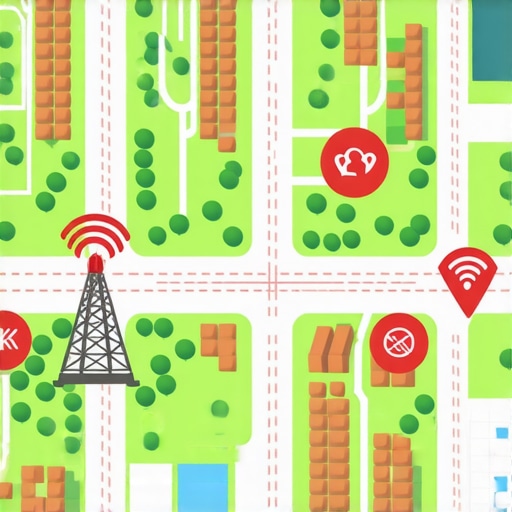
The Neighborhood Signals Google Uses to Verify Your Service Area
For the modern Service Area Business (SAB), the digital landscape is a landscape of ghosts. You operate a plumbing empire, a roofing crew, or a high-end med spa that offers concierge house calls, yet on the digital map, you are often invisible. This is the “Invisible Office” Paradox: you exist in the physical world, your trucks are on the road, and your tools are dirty, but because you lack a traditional storefront, Google’s algorithm treats you with a level of skepticism that brick-and-mortar businesses never face.
In the world of google business profile seo, the struggle is real. Many business owners find themselves “ghosted” by the map pack, appearing only when they are physically standing in their own driveway. This phenomenon occurs because Google’s local algorithm is built on three core pillars: Relevance, Distance, and Prominence. For an SAB, “Distance” is a moving target, and “Relevance” is often tied to a hidden address. If you’ve ever wondered Why Your Business Only Shows Up When You’re Standing in the Parking Lot, it is because your neighborhood signals are too weak to project your authority beyond your immediate vicinity.
To dominate the local map pack in 2026, you must understand that Google isn’t just looking for an address; it is looking for a footprint. This guide will deconstruct the “Neighborhood Signals” Google uses to verify your service area and rank your profile where it actually matters.
The Hidden Foundation: Verification vs. Ranking
There is a common misconception in the world of google business profile optimization that once a profile is verified, the address no longer matters. In reality, the hidden address you used for verification is the “anchor” for every calculation Google makes regarding your proximity. Even if you toggle the “hide address” setting, that specific latitude and longitude coordinate remains the center point of your ranking radius.
Kevin Pauls (Local SEO Consultant and GBP Product Expert) often highlights that Google treats the hidden address as the “center of gravity.” According to Pauls, Google cross-references this address against “Secret of State” filings, utility bills, and even the specific language in your lease. If your verification address is a virtual office or a UPS store, you aren’t just risking a suspension; you are capping your ranking potential before you even begin. Google’s AI is increasingly adept at identifying “non-standard” residential or commercial uses. This is why understanding The Only Lease Clause That Actually Forces a Successful Profile Verification is critical for long-term stability.
Verification is the entry fee, but ranking is the prize. To win, you must prove to Google that your “hidden” office is the legitimate hub for a business that actively serves the surrounding neighborhoods. This proof is delivered through a constant stream of neighborhood-specific data points.
The Neighborhood Signal Framework
How does Google “see” a business that has no storefront? It looks at the trail of digital breadcrumbs left by your operations. We call this the Neighborhood Signal Framework. It consists of three primary data streams: Review Geography, Geo-tagged Media, and Hyper-local Citations.
1. Review Geography: The Power of Customer Mentions
In 2026, a five-star review that says “Great service!” is almost worthless for ranking. To rank google business profile listings effectively, you need reviews that act as geographic anchors. When a customer writes, “The team came out to my home in Shady Oaks and fixed our HVAC system,” Google’s Natural Language Processing (NLP) identifies “Shady Oaks” as a specific neighborhood entity.
These mentions provide Google with the “Proof of Service” it needs to expand your proximity radius. Instead of chasing a high volume of generic stars, you should Stop Chasing Review Volume and Use This Storytelling Prompt Instead to encourage customers to mention their specific neighborhood or landmark.
2. Geo-tagged Media and AI Vision
While Google officially states that it strips EXIF data (metadata that includes GPS coordinates) from photos upon upload, the reality is more nuanced. Google’s AI vision is capable of identifying landmarks, street signs, and even the specific architectural styles of certain neighborhoods. When you upload a photo of a completed job site, Google’s “Vision AI” parses the background. If you are a roofer in Chicago and your photos consistently feature the iconic bungalows of the Portage Park neighborhood, Google associates your profile with that specific geographic area. Using high-quality local seo tools to manage and audit your media uploads ensures that your visual footprint matches your claimed service area.
3. Beyond NAP: Hyper-local Citations
The old SEO advice was to get as many “NAP” (Name, Address, Phone) citations as possible on generic directories. That strategy is dead. Today, Google looks for “Hyper-local” mentions. A link or a mention from a neighborhood association blog, a local Little League sponsorship page, or a regional “Best of” list carries ten times the weight of a generic Yelp listing. These signals tell Google that you aren’t just a business in the city; you are a business of the neighborhood.
Breaking the Proximity Wall
The most significant hurdle for any SAB is the “Radius Wall.” This is the invisible boundary – often 5 to 10 miles from your verification address – where your rankings suddenly drop off a cliff. To improve google maps rankings beyond this wall, you must transition from relying on proximity to relying on Prominence.
Google’s algorithm is designed to prevent “Map Spam” by limiting the reach of any single profile. However, you can push past this by creating localized relevance through “Service Area Pages” on your website. These aren’t just “City” pages; they are “Neighborhood” pages. If you want to rank in the next town over, your website needs to provide deep, localized value for that town. This involves:
- Showcasing projects specifically completed in that area.
- Linking to local resources or news.
- Securing The Local Link Building Strategy That Actually Moves the Needle for Map Rankings.
If you have ever wondered Why Proximity Still Kills Your Ranking Even With a Verified Office, it’s usually because your “Prominence” signals aren’t strong enough to outweigh the “Distance” factor. You are essentially asking Google to trust you in a territory where you have no digital footprint. To solve this, you must “force” your way in by documenting your activity in those neighboring zones. Learn How to Force Google to Show Your Listing in the Next Town Over by leveraging localized backlinks and neighborhood-specific project galleries.
Technical Proof: Documents & Evidence for 2026
The 2026 landscape for Google Business Profiles is increasingly litigious. Google is under immense pressure to clear the maps of “ghost” businesses and lead-gen scams. As a result, the “Appeal Loop” has become a nightmare for legitimate SABs. If your profile is flagged, Google won’t just take your word for it; they want technical proof.
According to Kevin Pauls, the “gold standard” for recovery and verification in 2026 includes:
- Utility Bills: Must be in the business name and match the hidden verification address exactly.
- Truck Wraps and Magnets: High-resolution photos of your branded vehicles parked at the verification address and at job sites. The The Truck Magnet Photo Hack That Proves Your Business Is Real is often the difference between a permanent suspension and a successful appeal.
- State Filings: Articles of Incorporation that match your GBP name and address.
Google’s AI also looks for “consistency of existence.” This means your business should appear in official registries and local tax records. If you are struggling with recovery, ensure you are using 3 Utility Proofs Google Won’t Reject for 2026 Profile Recovery to build a bulletproof case.
Auditing Your Neighborhood Signals
How do you know if your neighborhood signals are actually working? Many business owners fall into the trap of the “Green Circle” problem. They use a google maps rank tracker and see a sea of green dots around their office, but their phone remains silent. This happens because the “Distance” pillar is doing the heavy lifting, but the “Relevance” and “Prominence” pillars are failing.
A true audit of neighborhood signals looks at:
- The Geographic Spread of Reviews: Are your reviews coming from all over your service area, or just one zip code?
- The Diversity of Local Citations: Are you mentioned on local news sites or just generic directories?
- The “Search-to-Call” Ratio: Are people finding you for “Plumber near me” (Proximity) or “Emergency Plumber [Neighborhood Name]” (Relevance)?
If your audit reveals that you are only ranking within a 2-mile radius of your home, you are suffering from a lack of neighborhood signals. You need to identify The Missing Data Points in Your Current Local Profile Audit to determine where the signal is breaking down. Often, the issue is rooted in 5 Tactics to Fix 2026 Ranking Issues Caused by Map Spam, where illegitimate competitors are drowning out your legitimate signals.
Taking Ownership of Your Local Map Pack Position
Dominating the local map pack as a Service Area Business is not about “tricking” the algorithm; it is about providing Google with the structured and unstructured data it needs to verify your physical presence in the real world. By focusing on “Neighborhood Signals” – reviews that mention locations, geo-relevant media, and hyper-local prominence – you can effectively “exorcise” the ghosts that haunt your rankings.
The “Invisible Office” Paradox is only a problem for those who treat their Google Business Profile as a “set it and forget it” asset. In the high-stakes environment of 2026, your profile requires constant feeding of geographic proof. Whether you are fighting a suspension or trying to rank higher on google maps, the strategy remains the same: prove your location, prove your service, and prove your prominence.
If your profile is currently stuck in the “Ghost Zone,” it’s time for a professional intervention. Audit your signals, gather your technical proof, and start projecting your authority into every neighborhood you serve. The map is waiting for you to claim it.