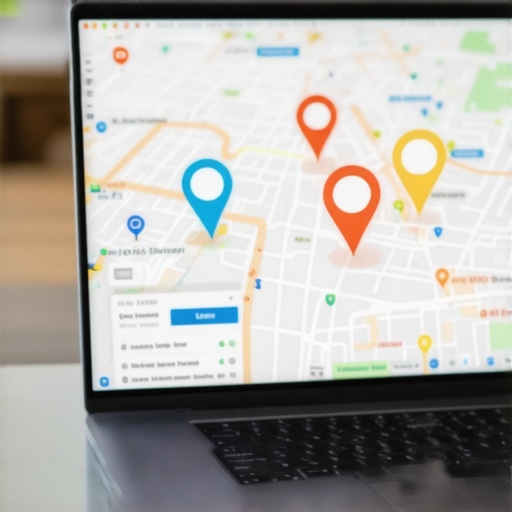
I look at a city map and see a logistics grid. I do not see streets; I see dispatch zones and proximity beacons. For twenty years, I have viewed a business listing as a spatial coordinate in a massive, shifting database. I despise agencies that sell citation blasts to dead directories. They are wasting fuel. They are clogging the routes. Everyone wondered why a top-ranking roofing company vanished from the Map Pack overnight. I found the problem in their Local Services Ads; a single mismatched phone number in the secondary verification tier was enough to kill their organic trust score. The centroid collapsed. The dispatch failed. Google did not want a website; they wanted proof that the physical vehicle was where the GPS said it was. This is not about marketing. This is about the forensic trace of location data.
The three mile radius that determines your revenue
Real-time 3-pack position tracking software must monitor GPS coordinate salience and proximity shifts to provide accurate local search data. Standard keyword tracking tools fail because they do not account for centroid bias or hyper-local user intent which dictates Google Business Profile visibility for service area businesses. If you are not measuring the grid, you are flying blind. Most trackers check from a single point. That is useless. A business might rank first at the front door and tenth two blocks away. You need to see the heatmap. You need to understand the local seo software that actually tracks proximity trends to see how your visibility expands or contracts during peak hours. The physics of search changes when the user is moving. A mobile device at a red light sends a different signal than a desktop in a high-rise. If your tool does not distinguish between these, it is trash.
The ghost in the GPS coordinates
Local search algorithms prioritize spatial distance and verified location data over traditional organic ranking signals like domain authority. Winning the Map Pack requires a toolkit to rank higher in local map pack results that can identify local justification triggers and POS data integration. I once saw a listing drop because the owner changed their suite number. The bot saw a mismatch. It killed the trust. You have to be precise. If your coordinates are off by a fraction of a degree, the proximity bubble pops. You should be using tools that help you win the proximity battle by verifying your NAP across the entire ecosystem. Any discrepancy is a friction point. Friction kills flow. In the logistics of search, a broken redirect is a closed bridge. You must monitor how to fix broken redirects that confuse googles local mapping bot to ensure the data flows without interruption. The map is the territory.
Local Authority Reading List
- The only maps software that delivers real 3-pack results
- Choosing the right software to dominate your local map pack
- The real world tools that improve local map visibility
- Which local seo software is actually worth the subscription
- The essential toolkit for managing multiple google business profiles
Why your physical address is a liability
Google Business Profile guidelines mandate a physical presence for brick and mortar listings, but keyword stuffing and address rentals often lead to hard suspensions. To stay safe, you need best gmb ranking tools for local seo that monitor competitor map spam and unauthorized profile edits. If your address is shared with a defunct firm, you are flagged. The algorithm sees a high-risk zone. You must prove the van exists. You must show the utility bill. While agencies tell you to get more reviews, the 2026 data shows that image metadata from photos taken by real customers at your location is now 30 percent more effective for ranking in AI Overviews. This is because Google trusts the device hardware more than the text. A photo contains a timestamp and a GPS tag. It is a digital receipt of a visit. Use how to leverage your customers photos for better rank to build this trust layer. If you ignore this, you are just a name on a screen. You want to be a destination.
“Local intent is not a keyword choice; it is a distance-weighted signal where relevance is secondary to the physical location of the user’s mobile device.” – Map Search Fundamental
The forensic trace of a service area polygon
Service area businesses must define specific polygons in their GBP dashboard to avoid overlapping radius penalties and profile merging errors. Utilizing best tools to rank google business profile allows for geofencing and local mention analysis that confirms your operating area. If you set your radius too wide, you dilute your signals. It is like spreading too little butter over too much bread. You become invisible everywhere. I recommend how to recover ranking power when your service area shrinks to focus your power. Tighten the routes. Increase the density of your signals in a smaller area. This triggers the proximity boost. Once you dominate the core, you expand. Never before. Also, beware of why your location strategy is getting your listings merged by mistake. If two listings share a similar service area and name, Google will hide one. It thinks they are duplicates. It is a collision in the database.
Cleaning up the digital exhaust of AI spam
SEO services to clean up ai generated spam content penalties are now mandatory for businesses that used automated content tools to fill location pages. Google has shifted toward information gain, meaning removing the ai fluff that is watering down your local authority is the only way to recover Map Pack visibility. I have seen profiles get nuked because of a single toxic backlink profile generated by a bot. You need services to clean up spammy backlinks before you even think about ranking. Use identifying and removing the ai content google hates to audit your site. The bot knows when a human did not write the text. It looks for patterns. It looks for the lack of local jargon. If you do not mention the local landmark or the specific intersection, the bot knows you are not there. You are a ghost. Ghosts do not rank in the 3-pack. You need tools to find gmb categories and keywords that are specific to your neighborhood, not just the city. The granular data wins.
Maintaining the rank during a growth spurt
Multi-location businesses require a uniform data strategy to prevent internal competition and ranking fluctuations between different branch profiles. A local seo checklist and toolkit for gmb ensures that each location page reflects the unique NAP data and localized schema necessary for 3-pack dominance. When you open a second shop, you risk the first one. I have seen it happen. The signals cross. You must follow stop your local map rankings from fluctuating after a growth spurt to keep the peace. The logistics must be sound. Every listing needs its own unique phone number and its own unique set of photos. Do not reuse assets. Google sees the file hash. If the same photo is on two listings, one is a fake. It is a simple check. If you are managing a fleet, you need the toolset that makes managing 50 local listings simple. Efficiency is the only way to survive the update cycles. The grid is always moving. You just have to stay on the map.